From Patients to Progress: Why the Right CRO Determines Clinical Trial Success
A clinical trial can have an innovative molecule, a scientifically strong protocol, and significant investment behind it - yet still struggle to reach its objectives.
Why? Because clinical research is ultimately an execution business. The difference between a study that progresses smoothly and one that repeatedly encounters delays often comes down to how effectively the clinical research ecosystem operates around the protocol.
This is where the right Contract Research Organization - or CRO - can make a meaningful difference.
A CRO is not simply an outsourced administrative function. The right CRO becomes an extension of the sponsor's team.
A Protocol Is Only the Beginning
Every clinical trial starts with a scientific question and a protocol. But a protocol does not recruit patients by itself.
It does not activate sites. It does not coordinate investigators. It does not resolve operational issues. And it certainly does not ensure that every piece of data generated during the study is complete, consistent, and reliable.
Turning a protocol into a successful study requires hundreds of operational decisions. The CRO's role is to help translate the scientific plan into real-world execution.
Patient Recruitment: Where Strategy Meets Reality
Patient recruitment is one of the most visible challenges in clinical research.
A site may appear ideal on paper but have limited access to the specific patient population required by the protocol. A strong CRO therefore needs to look beyond the number of patients visiting a hospital.
It must understand:
● Disease prevalence within the site's population
● Investigator experience
● Referral patterns
● Patient eligibility
● Competing studies
● Site resources
● Recruitment infrastructure
● Patient retention capabilities
The objective is not simply to identify sites with large patient volumes. It is to identify sites capable of delivering the right patients for the study.
The Right Sites Can Change the Timeline
Site selection is one of the earliest strategic decisions in a clinical trial.
Selecting the wrong sites can create downstream consequences:
● Slow recruitment
● Low screening-to-enrollment conversion
● Increased monitoring requirements
● Protocol deviations
● Higher operational costs
● Site closure or replacement
A capable CRO brings local knowledge into the site-selection process. Its value is not just in providing a list of hospitals.
It is in understanding which sites are genuinely capable of executing the protocol.
Regulatory Execution Matters
Clinical research operates within a complex regulatory environment.
In India, CDSCO oversees clinical trial approvals and related regulatory processes under the New Drugs and Clinical Trials Rules, 2019. Its responsibilities also include global clinical trial oversight, review of protocol amendments, safety documentation, ethics committee approvals, and GCP inspection activities.
For a sponsor, understanding the regulation is only one part of the challenge. The greater challenge is translating regulatory requirements into operational execution.
A capable CRO helps coordinate the documentation, submissions, site requirements, ethics processes, and communication necessary to keep a study moving while maintaining compliance.
Site Management Is an Ongoing Relationship
Clinical trial sites are not simply activated and forgotten.
They require continuous engagement.
Investigators and research teams need:
● Clear communication
● Training
● Protocol support
● Monitoring
● Issue resolution
● Timely responses
● Consistent sponsor interaction
Strong site management creates a relationship in which operational problems are identified early rather than after they become major delays.
Data Quality Begins at the Site
When people talk about clinical trial data, the conversation often focuses on the database.
But data quality begins much earlier.
It begins with:
Patient → Investigator → Site Team → Source Documentation → Data Capture
If information is incomplete or inconsistent at the point of collection, correcting it later becomes more difficult.
A strong CRO therefore builds quality into the study from the beginning through training, monitoring, documentation, and standardized processes.
Technology Can Accelerate the Process - But People Still Matter
Clinical research is becoming increasingly digital.
Electronic data capture, remote monitoring, digital patient engagement, centralized data review, artificial intelligence, and other technologies are changing how studies are conducted.
But technology does not replace clinical judgment.
The strongest CRO model combines:
Technology + People + Process
Technology can identify a signal.
An experienced clinical team understands what that signal means and what action should follow.
Communication Is an Operational Tool
One of the most underestimated elements of clinical research is communication.
Sponsors need visibility.
Investigators need timely answers.
Sites need support.
Patients need appropriate engagement.
Clinical teams need escalation pathways.
A strong CRO creates a communication structure in which issues are surfaced early, responsibilities are clear, and decisions can be made quickly.
In clinical research, silence is rarely a sign that everything is going well.
Good CROs create systems where problems are visible early enough to be solved.
What Sponsors Should Look For in a CRO
Choosing a CRO should go beyond comparing service lists or pricing.
Sponsors should consider:
● Relevant therapeutic experience
● Investigator and site networks
● Patient recruitment capabilities
● Regulatory expertise
● Quality management systems
● Clinical operations experience
● Data management capabilities
● Communication and escalation processes
● Technology infrastructure
● Ability to scale
● Transparency and accountability
The right CRO should be able to explain not only what it will do, but how it will do it.
The Emerging Role of Indian CROs
As India becomes increasingly important in global clinical research, Indian CROs have an opportunity to become more than local execution partners.
They can become strategic bridges between global sponsors and India's clinical ecosystem.
The value comes from combining local knowledge with international research expectations.
This includes understanding the local healthcare environment while maintaining processes aligned with global clinical research standards.
For global sponsors, that combination can reduce the distance between a global protocol and local execution.
Vector BioSource's Perspective
Our experience at Vector BioSource has taught us that clinical research does not happen in isolation.
It depends on relationships - with hospitals, investigators, patients, laboratories, regulatory bodies, logistics partners, and research organizations. Our expansion into CRO services is a natural extension of that ecosystem.
By combining clinical operations expertise, hospital relationships, biospecimen capabilities, regulatory understanding, and global collaboration, we aim to create a research model that supports sponsors from study planning through execution.
Our goal is not simply to become another CRO.
It is to become a partner that understands the scientific objective behind the study and works backward from that objective to build a practical, high-quality execution strategy.
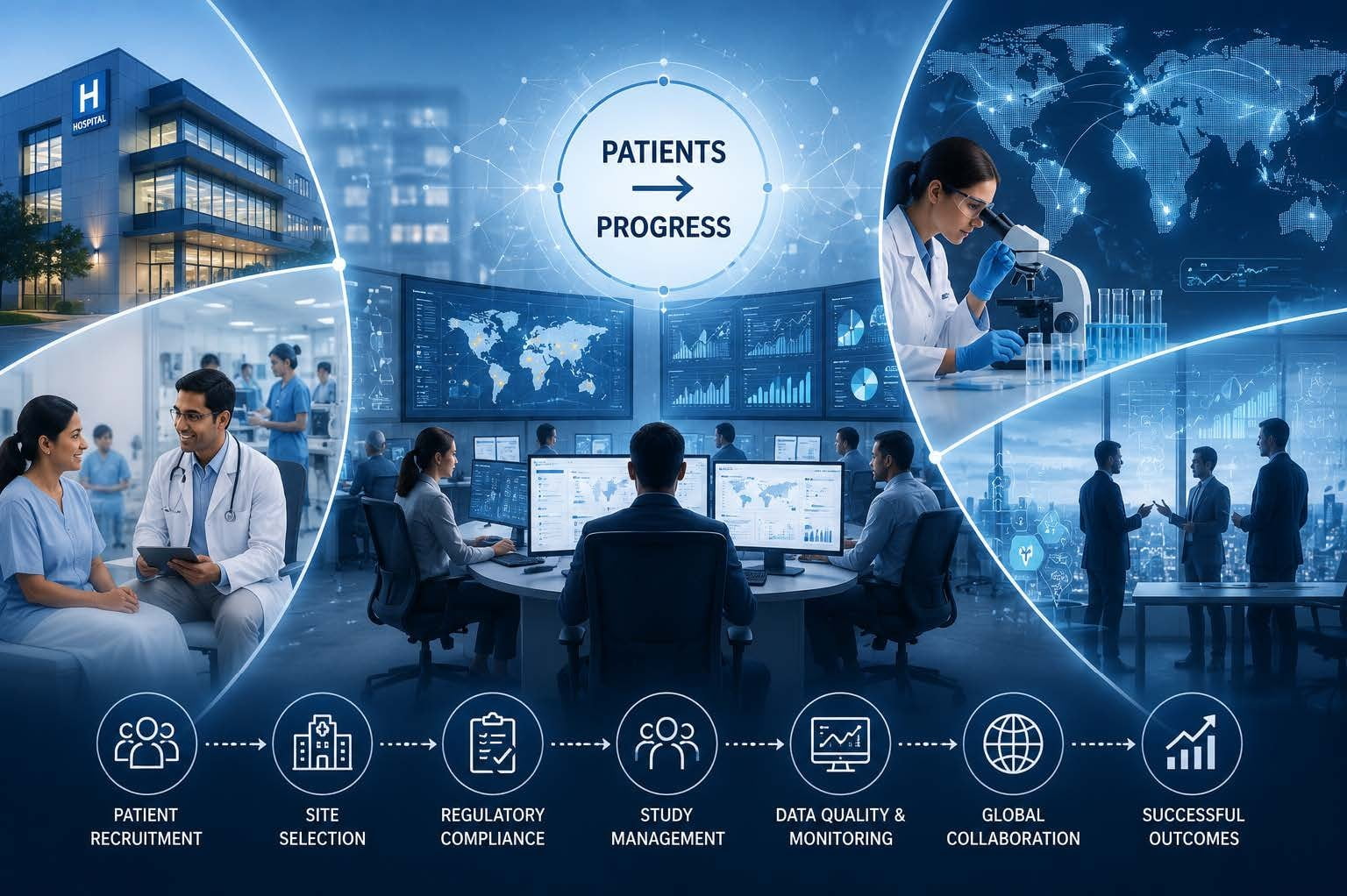
From Patients to Progress
Every clinical trial ultimately comes back to the patient.
Behind every protocol is a person who may be seeking a new treatment.
Behind every dataset is a patient whose participation contributes to scientific knowledge.
Behind every successful study is a network of people working together to protect that contribution.
The right CRO helps connect all of those pieces.
Final Thought
A successful clinical trial is not created by a protocol alone.
It is created by people, processes, sites, patients, data, technology, and trust working together.
The right CRO brings these elements together and turns a scientific plan into real-world progress.
At Vector BioSource, we believe that is what clinical research partnership should mean.
- Roshan Patil
Director of Clinical Affairs | Vector BioSource Inc.